Showing posts with label Cooking Class. Show all posts

Friday, May 24, 2019

Back in Cairo

I booked this cooking class via Airbnb. The cooking class was scheduled from 2:00pm and I was wondering whether the hosts were going to taste the food with me since it's during Ramadan. Then, I found out that they are Christian. That makes sense...

Unlike a more commercially organized cooking class, this is a very intimate experience because the host's home is located in the residential area, which is 40 minutes away from the Cairo's city center. I took a metro to the closest station and the host came to pick me up. I've been annoyed by the very pushy vendors during this entire trip. But I had a nice chat with a local person in the metro and met a very friendly train station staff member. I'm glad that I left the touristy area and had a chance to interact with nice local people.

When I arrived at the host's apartment, I was welcomed by the host, his wife and their two adorable kids. I felt like I was visiting a local friend's family. Soon after I arrived, they served me a Turkish coffee in the Egyptian style.


The host's wife is the instructor. She is pretty young but a very good cook. I gave them a list of dishes that I wanted to learn. To accommodate my requests as much as possible, she prepped many things and made some dishes in advance.

The main dish of this cooking class is koshari. She prepared some topping, such as garbanzo beans and lentils ahead of time because they needed to be boiled with spices and aromatics. But of course, she left the important steps for me.


The tomato sauce for the koshari is made with both fresh tomatoes & tomato paste and garlic. The ingredient that sets this apart from Italian tomato sauce is the cumin.


It was very delicious! It's better than the one I tasted during the tasting tour on the first day.


Since I mentioned that I like it spicy, they made the chili sauce on the side. 


This is garlic vinegar. I saw this on the table as a condiment when I had the koshari on the first day. I was wondering what it was then. Now, I know.


Most of the tahini sauce I've had at Mediterranean restaurants in the US seems like it's just tahini. But the Egyptian version is mixed with vinegar. I saw this at almost every restaurant. It must be an essential condiment in Egyptian cuisine.


This is another side dish that I had at every restaurant. So-called Mediterranean salad but their vegetables are cut into bigger pieces than in the other countries, I think. The dish on the left is Ful medames (stewed fava beans with spices). I've had this so many times since I've been in Egypt. But they poured on the tahini sauce that is mentioned above. That acidity made the flavor more clear. The ful was made in advance. 


This is another type of ful with tomato sauce.

She made moussaka the day before as well. The Egyptian version doesn't have bechamel sauce or potato. It was more like stewed eggplant. Very flavorful.


This is the real feteer. Unlike the one I had at the restaurant in Luxor, it's much flakier. Since it takes long to make this, they made it the day before.


These are unique sweets that are eaten during Ramadan, called qatayef. When I was waiting to be picked up at the metro station, I saw a few street vendor selling small pancakes. Now, I know the pancake is for this. I asked a few guides whether there any special dishes during Ramadan but they all said nothing. I wonder why they didn't mention this... Dates and nuts are wrapped inside the pancake, deep fried and soaked in syrup. I was expecting something greasy and super sweet but it wasn't like that at all. I really liked them.


It was very enjoyable cooking class experience. Moreover, the host took me to a church afterwards. This was way more than just a cooking class.


I had lots of food at the cooking class so I wasn't that hungry for dinner. But this is the last chance to have Egyptian food since I'm leaving tomorrow morning. So, I pushed myself and headed to my first (and last) seafood restaurant in Egypt. This is a branch of a restaurant in Alexandria. Alexandria is facing the Mediterranean so that they have an easy access to fresh seafood. I wanted to go to Alexandria for the seafood but I wasn't sure if that was worth it during Ramadan. So, here's my compromise.


The name is Kadoura restaurant. All the fresh seafood is displayed and I can choose what I want before seating. The communication wasn't easy but I ordered soup and rice. I wasn't sure if that's complimentary or charged... The soup was creamy so that I thought it may taste like seafood chowder. But it's less sweet and a bit more salty. And it was very thin. 


According to what I read later, this rice was cooked with seafood broth. But it didn't have much flavor.


Nice size shrimp. It's a bit overcooked.


I picked sea bass-like fish. The texture was similar but the flavor was slightly different. I was surprised that they grilled it with the guts inside. I'm not sure if that's the Egyptian style.


Despite the restriction in food options due to Ramadan, I think I did pretty well trying various foods in Egypt. I'm leaving for Dubai tomorrow. It's supposed to be an overnight layover. But I decided to spend another day.

Friday, December 28, 2018

Kuala Lumpur Day 2

The cooking class from this trip is through New Malaysian Kitchen. The cooking class took place at a house outside the city center. I was aware of this, but I misread the directions and was waiting at the wrong station. Based on the previous cooking class, I was expecting the pick up location to be near the city center.... I guess this is a new type of class run by an individual rather than by a company. Because of that, I was late by more than one hour but the chef still let me cook all 4 dishes and a drink (when I booked the class, I chose 4 dishes from the list).


The house had a nice size garden and her family grows a variety of herbs.


Welcome amuse bouche. Nicely acidic with rice vinegar. 


Also, she served a tea made with the flower (shown behind the tea) from the garden. The photo doesn't show it unfortunately, but it's a nice blue drink. I've seen purplish drinks but this was really blue and no artificial color added.


Now the cooking class began. The class was very informative. She started to explain Belacan, which is a key ingredient to many of Malaysian foods. Belacan is fermented shrimp. Shrimp paste is used in most southeast Asian countries with different names. But it seems shrimp paste is more popular in Malaysia. Original shrimp paste is quite stinky, so it's fried to reduce the stickiness and increase umami. In addition, the product below is dried - the chef recommended this type because it's easy to use and also keeps for long time. I was planning to buy a few to bring back home but I forgot.... I hope I can find it at the local Asian Market.


The chef gave me options to grind ingredients, either by food processor or mortar & pestle. Of course I asked more more traditional method, which is mortar & pestle although it takes longer. She told me this particular mortar & pestle is made from stone and it's not made anymore.


This is my most favorite dish of the 4, Kerabu Okra. The topping is the ground belacan, chili and other seasonings along with shallot. We made two versions, cooked and uncooked. I thought I would like the cooked version because of the cooked shallots and more cohesive flavors. But surprisingly, I much prefer the uncooked toppings because of the freshness.


Another interesting dish is the dessert, sweet potato and coconut balls. The ball is made with rice flour so that this is gluten free. I don't care if my foods are gluten free or not. But many Asian dishes are naturally gluten free.


Here are the 4 dishes and a drink (Teh Tarik) I made. The other 2 dishes included Chicken Rendang (stewed chicken) and Char Koay Teow (Stir fried noodle). They are both very popular dishes in Malaysia. Beef Rendang is better known but it wasn't on the list, unfortunately. Teh Tarik is a black tea mixed with condensed milk.


The seasoning and flavors are more modest compared to the neighboring countries, such as Thailand, India and Indonesia. Normally the seasoning tend to be heavy in the tropical to sub tropical area because of the heat. I would have liked a bit more kick while I'm in such hot and humid place, though.

I'm flying to Singapore tomorrow. Using the 10 hours of layover, I'm going to join another food tasting tour.


Monday, May 28, 2018

Bhutan day 3

Because I kept telling the guide that I wanted local food (not dishes for tourists), he took me to a local noodle restaurant. It's located in a hidden corner of the building. It looked very "local"!! The restaurant specializes in momo (a popular dumpling, which is usually known better as a food from Nepal) and handmade soup noodles. The style of handmade noodle reminds me of the Western Chinese cuisine, such as Uyghur foods. Basically Bhutan is a rice-country and wheat flour is not as popular as a starch. Probably it originated from the western part of China via Tibet.

The sign to the restaurant

Inside the restaurant


Both steamed and fried momo with spicy sauce, which was spicier than one I had at a Nepalese restaurant in the US.


Their specialty soup noodle. I chose beef topping. The soup is the same no matter what topping you choose.


Bhutan is a Buddhist country. While most nations are not vegetarian, Bhutan doesn't even kill animals. The guide told me that all the animals for food are slaughtered in India and exported to Bhutan. Do Indians kill cows? The guide was guessing probably Muslims in India do the job. Very strange arrangement....


Tonight, I'm participating in a "farm stay". It's an inn run by a family. So, it's a kind of home-stay. It's located north of Paro (between Paro and Tiger's Nest). Like many other families in Bhutan, they have small farms for veggie, eggs and milk. 


I was welcomed with suja (butter tea) and milk tea (chai without any spices). Teas are usually served with roasted rice and roasted and pressed corn. Both are not very puffy but rather tough. Bhutanese are not into sweets so everything is only lightly sweetened.  


This farm-stay includes a cooking class taught by the mother of the family. I requested that I want to learn their national dish, ema datsi. Despite the great flavor of ema datsi, there was no secret. Simply cook fresh chili (it can be dried chili), onion (shallot) and tomato (optional) with two kinds of cheeses (cow and yak) in vegetable oil and water. The only seasoning is salt. The cow cheese is a little closer to feta in terms of texture. But there's no salt and it has a hint of tanginess. The yak cheese seems like a harder version of mozzarella (not the fresh mozzarella in water). I wasn't sure what cheese I can substitute to make ema datsi once I get back to the US. The guide said I can use Amul cheese from India to replace the Bhutanese cheese.  


The dinner included 4 dishes served with red rice and lettuce grown at their farm. The red rice is only slightly red. 


Tomorrow is the highlight of the trip, Tiger's Nest.  

Wednesday, November 22, 2017

Chengdu 3rd full day

As usual, I was looking for a cooking class during this trip. Despite the reputation of being a "foodie" city, it wasn't very easy to find the right class. The price point is rather high compared to other Asian countries. I guess szechuan food is not for everyone and there isn't enough demand? Based on what I saw in the city, there are very few foreigners in Chengdu.

Today is the last full day and I scheduled a half day cooking class. The school offers lunch time and dinner time and I chose the lunch option, which is between 9:00am and 1:00pm. I knew there'll be tons of food to eat after the cooking class. But I got breakfast from street vendors outside the hotel anyway... The hotel is located in the city center and there are quite a few vendors on the busy street to serve breakfast for the local business people who work in the city.


One of the most standard breakfast dishes in China is porridge. There are many But I thought the way they serve it is very unique.  The container is a clear plastic cup with a lid served with straw. I guess I'm supposed to suck the porridge from the straw like a drink.. It's weird but clever.


Shiu mai


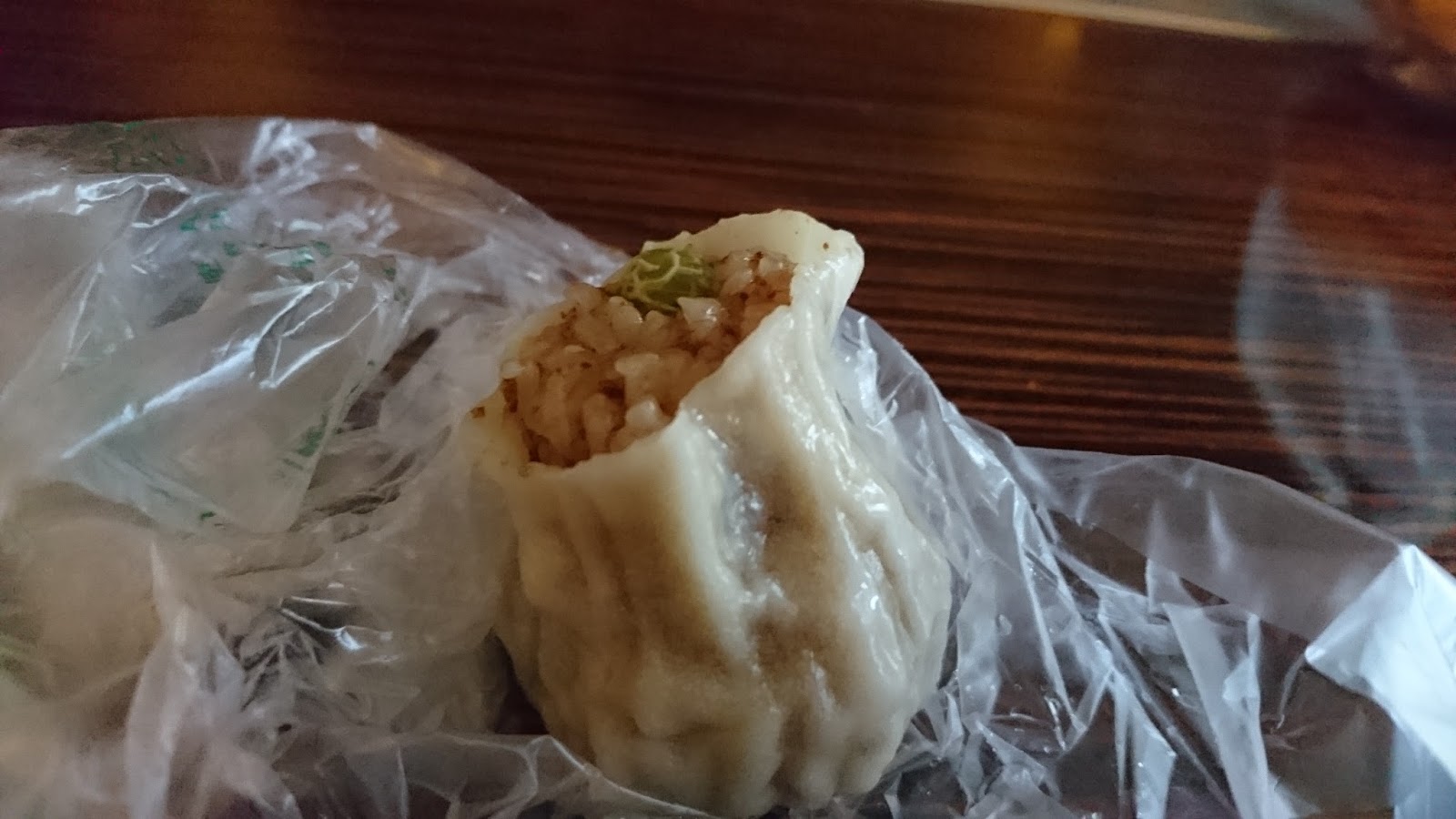
Steamed bun with read bean paste inside


Fried dough - another typical breakfast food (not necessary a specialty in Chengdu, though)


After the breakfast, I headed to the cooking class. The school is called Chilli Cool, which I booked through Viator (which normally doesn't show's each business' name). Today's class is just for me and an Italian girl who speaks multiple languages including Mandarin (she said she doesn't understand the locals in Chengdu because of their heavy accent). Like other cooking classes I've attended, it started with a market tour. This is as important as the actual cooking for me because I get to see the local's food life with an expert. Usually vendors at the market are very friendly when I have a local guide. This market was no exception. Chinese are not particularly known to be friendly people. Up to this point, I haven't seen many friendly locals. But with the hostess of the cooking class, I had a very pleasant experience.


It's a bit graphic... Rabbits without heads. Hair on the legs is left for some reason.


I thought all the thousand year eggs are black. But some are yellow


The hostess stopped by at the vendor that makes the dumpling that looks like tortellini. I was able to make some with the vendor. It's funny that we did this with the Italian classmate. I told her I learned how to make tortellini when I took the cooking class in Bologna.


The color of the carrot is what it is. Not because of the light or my camera. I have never seen such  a reddish orange carrot. I had to ask if this is something else...


After the market tour, we came back to the kitchen. They renovated a Japanese restaurant so that I saw a few items of Japanese decor. 


First, we started to prep the veggies and fish. Half of the fish was already prepared, but I sill had to remove some belly bones and slice it thinly. It took me a while to get used to the Chinese knife. It was pretty heavy... But I got compliments on my knife skills 😁


The seasoning, including aromatics, such as garlic and scallions, are pre-prepared.


I took a picture of the chili paste that we used in the class. It's made with chili, oil and fermented broad beans (fava beans). It's pretty salty by itself. I got this chili paste at the local market after the class. 


The first dish is twice cooked pork (Hui guo rou). The pork is cured (cooked once). Then cooked again so that it's called twice cooked pork. When I had this dish last night, I wasn't sure what veggie was used but I know it now. It's garlic stems. I've had garlic stems (sprouts) before. Once it's cooked, the green parts are very similar to Chinese chives (although chives are much thinner). That's why I though it was Chinese chives yesterday. 


Sauteed eggplant with fish flavor (Yu Xiang Qie Zi). However, there's no fish in it (not even fish sauce). 


A cold dish, called Three slices salad (Liang Ban San Si). Julienne veggies tossed in spicy and sour sauce


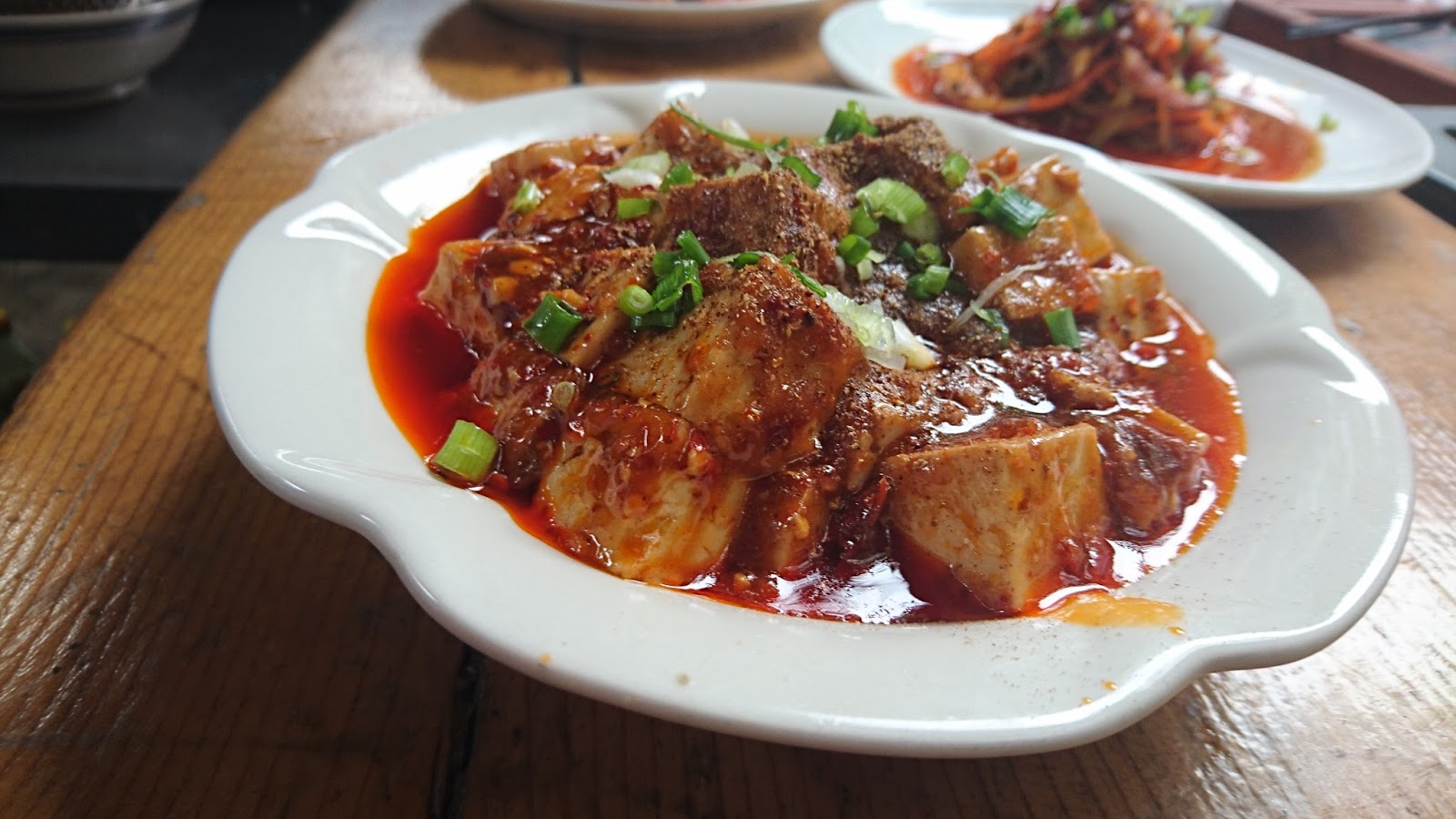
Ma po tofu. It was pretty close to what I had last night at Chin Ma Po Tofu restaurant


The last dish is fish with pickled green (Suan Cai Yu). I requested this dish. (I also requested the cold chicken in chili oil but it was turned down because it's too time consuming to complete within the class schedule). This is one of my favorite szechuan dishes. But now, I'm a bit hesitant to try it again because of the amazing amount of lard used in the broth. No wonder it always tasted so rich despite the lean and flaky white fish. The fish is fresh water fish and that's totally understandable based on where Szechuan province is located. 


All the dishes are made with MSG. Since I'm not against MSG, I'm just fine. But I always wonder how it used to be made before MSG was invented. It's costly and time consuming to get the same level of umami without using MSG. Probably Chinese before the MSG era used to spend more time extracting more umami from other foods?   


There was tons of food after we finished cooking - I believe we didn't even finish a quarter of it. I was really stuffed. After a brief rest in the hotel, me and my friend went to the very center of the city. My friend found an amazing pastry filled with spicy meat (he explored the city before I arrived). He told me that he couldn't help finishing although it was super spicy. I was still full but I had to try it because today is the last chance. 

It was a very small venue and it had a line of 20 people. Because their oven capacity is limited and line moves only the pastries are baked (approximate 20 pieces at a time). And we have to wait another 15-20 min for the next batch. I think I waited for 30 min or so. 


There are different fillings to choose from but I picked regular (there was spicier version but my friend told me the regular should be spicy enough). 


My friend was right! It was spicy enough. Also super hot (temperature-wise) because it's just right out of the oven. However, it was DELICIOUS! It was VERY numbing and addicting. It is a bit too oily but still tasty.


The dinner is not for the food's sake. My friend found a Chinese traditional dance show (including Bian Lian, which is a mask changing performance) that comes with pre fix dim sum dinner. Since I was very full, dim sum dinner was perfect. One dish I wanted to try before I leave Chengdu is tan tan mian, which is unseasoned noodle served with spicy meat sauce on top. In fact, that was the best dish of the meal.


I'm leaving for Japan tomorrow morning. I wish I could have more food....