Wednesday, May 31, 2017

Belfast - Bushmills

Belfast, Northern Ireland, does not seem like the typical tourist destination. However, I like to include non-touristy areas in my trips to see something more local. Also, I found there's a Bushmills distillery, which is one of the major Irish distilleries, located 1.5 hours northwest of Belfast.

Unlike Scotland, most major Irish whiskies belong to 4 major distilleries. Because of different factors, such as alcohol prohibition, decline in demand, etc. smaller Irish distilleries were forced to close and bigger distilleries acquired them. One of the major distilleries is Bushmills. I was less interested in Irish whiskey because it felt more "manufactured" than Scotch whisky, so I signed up for a tour mainly to Giant's Causeway with a short stop at Bushmills,

Before I got to the meeting point for the tour, I stopped by at Harlem for breakfast. My purpose was the full Irish breakfast! Irish breakfast is known for the substantial portions. It comes with pancakes, black pudding, fried egg, bacon, sausage, mushroom and tomato. Flavor-wise, there's nothing special. I just wanted to experience an "Irish breakfast." Again, the sausage seemed to have some filler.  


The first stop of the tour is Giant's Causeway. These hexagon shaped columns were formed naturally. It's amazing!


I knew that visiting Bushmills distillery was not the main event of the tour. But it was too brief a stop, unfortunately. The departure of the tour was a little delayed and it seems the driver shortened the time we stayed at the distillery. Besides, this was the lunch spot too. After finishing lunch at a very crowded cafe in the distillery, all I had was 20 minutes or so. I knew I didn't have time for a tour but I managed to try their tasting and buy a bottle.


One of the three samples I tasted was a 12yr single malt. They said it was sold only at the distillery, so I bought one bottle.


After I came back from the tour, I went to another pub, called Robinson's, which is close to the drop off location. I was trying to get into the restaurant section, which is on the second floor. It was a touch late and the group in front of me took the last table... The restaurant staff told me that I could still have food at the pub downstairs, although the menu is limited.

But I enjoyed the real "Pub" feel with the not-so-elaborate foods. The Shepherd's Pie was excellent. It was pretty big. The meat underneath was not too salty but packed with flavor. I tasted more tomato in the meat sauce, probably tomato paste (not ketchupy). Although it was 3/4 potatoes, the balance was working out.


This is an obviously Irish dish, which is called Irish Stew...  It's made with lamb, carrot and potato. The potato was half pureed. The pureed potato gave the stew some thickness. Again, very flavorful, but the portion was much smaller compared to the Shepherd's Pie.


I'm taking a train to the last destination, Dublin, tomorrow. I'll spend 2 more nights there.


Tuesday, May 30, 2017

Belfast

Today is a moving day, just flying from Aberdeen to Belfast (Northern Ireland). After such a super packed day yesterday, I guess I needed a one day break to rest.  Before I planned this trip, I didn't know about UK/Ireland history. Northern Ireland is a different country from "Ireland" and it belongs to the UK so that the currency is British pounds. Although Northern Ireland is not a part of "Ireland" politically, this is still Ireland.

For dinner, I went to a historical pub, called Morning Star. This pub was built in 1810. A very nice rustic pub. It's pretty big inside, though. When I got in there, it wasn't too crowded. And I chose a table close to a window. Here is a sign displaying a joke. I thought it's a good one....


The first beer I ordered in Ireland, Hop House 13. I didn't know when I ordered, but this is made by Guinness. It's light & nicely hoppy, summery beer. Very easy to drink.


Our waitress was a very upright grandma type. Initially, I ordered raw oysters and pork belly. She told me bluntly that oysters are not good today and that the pork belly is too fatty. I appreciated her honesty...


So, here's the first appetizer, seafood chowder. It had a little strong "sea" smell. Despite the smell, the seafood tasted fresh. It was a very flavorful chowder. Interestingly, a wedge of lemon was "in" the chowder. I'm not sure if that's the way it's supposed be or whether it just dropped and sank in the chowder? I found it at the bottom of the bowl....


The second appetizer is beef croquet. Very smooth texture inside.


Today's special mussel that the waitress recommended. I liked this a lot more than the one I had in Edinburgh a couple of days ago. The broth is the right amount compared to the number of mussels. So, the broth was packed with shellfish flavor. Plus, a good amount of diced chorizo and chili. Very complex and rich broth.


Bangers and mash is also called sausage and mash, a traditional dish of British Isles. The sausage is home made. From the texture, it seems there's some filler in the sausage. Nonetheless, a very good flavor with the rich gravy, which is almost like demi glace. The fried onion on top is a nice accent.


All of the dishes contain potatoes in different forms. I guess I'm really in Ireland...


Monday, May 29, 2017

Aberdeen - Speyside

Today's post will be the longest ever. I didn't want to pack so many thing in one day but there wasn't other option because of the rest of the schedule.

I left Edinburgh very early in order to catch the train to Aberdeen. The Speyside area is located between Aberdeen and Inverness, and it takes 1.5 hrs from either location. Like most wineries, distilleries are very difficult to reach by public transportation. So I booked a taxi for the day and planned to visit a few distilleries in Speyside. That could have been enough for the day, but I also found that the Brewdog Brewery is located north of Aberdeen in a town called Ellon. Anyway, I had only 5 hours to actually spend in Speyside but I was planning to visit 3 distilleries, so I knew I couldn't afford any delay....

My first stop was Glenfarclas. Glenfarclas is one of a few family owned distilleries left in Scotland. I booked a tour that would last a little more than an hour (or so they said). I arrived a little early because there wasn't any traffic. But the tour started a bit late.

Since it was Monday, I was hoping that there would be active production, but the guide said she wasn't sure there would be because the previous week was extremely hot and they shut down production for a few days. I think they can do this because this is relatively smaller family owned business. If they had too many employees, they couldn't have just skipped a few days....

The tour started from the barley grinder. Barley is soaked in water to malt (germinate) in order to create sugar and enzyme (for later fermentation). Then, the malted barley (or simply malt) is roasted with peat. The peat makes the smoky flavor and the amount of peat used in the roasting varies between distilleries. Whiskies in Islay are very heavy on peat and Lowland and Highland are light on peat. I would personally believe that Speyside is in between. Unfortunately, most of the distilleries no longer malt the barley at their own site, but rather purchase it from malters. That's why their first step would start from grinding.

The ground malt is mashed in the mash tun with water. The enzyme created during the malting process breaks down the starch in the barley into sugars. Since there is a best temperature for the enzyme to be active, they maintain the appropriate temperature for the best efficiency. As a result the grain/water mixture becomes sweet and is called "wort".


The wort is transferred to another tank for fermentation by adding yeast. The outcome at this point is the same as beer. The only difference is that when creating whisky, they release all the carbon dioxide. The top of the tank is not completely sealed and it can release the gas. The fermentation is continued until the alcohol level reaches around 10%. 


The signature look of traditional distilleries, the copper pot still, is pretty impressive! Most scotch whiskies are distilled twice. The fermented liquid is heated to the temperature at which only alcohol evaporates (since boiling temperature of alcohol is lower than that of water). The evaporated alcohol is condensed to liquid. This process separates alcohol and water & residue. This is repeated once again (for double distillation). 


The box shown below is a "spirit safe" that prevent any of the alcohol from being removed during distillation before it can be taxed (either by dishonest "thirsty" employees). Different shapes of glass bowls, along with a thermometer and hydrometer are installed inside the glass covered box. It allows for adjusting the mixture of different stages of spirit as the liquid exits the pot still. At this point, the liquid has no color; the color is created during maturation in the casks. 


Here are a variety of casks, such as sherry, port and bourbon. As at other distilleries, sherry casks are used at Glenfarclas for high grade single malt whisky. 


After the tour was done, they provided two tastings, 12 yr and 15 yr single malts. Because the tour started a little late, it didn't finish until almost noon, when the next tour at Cardhu starts. So, I didn't have much time to enjoy the tasting. They both tasted great, but obviously the 15 yr is a lot smoother. Neither one was too smoky. As soon as I finish the tasting, I moved to Cardhu, but I was late by 10 minutes. Unfortunately, I didn't make it and the next tour (and only slot for the remainder of the day) started at 1:00 pm. In order to accommodate this change, I had to give up on lunch (there was no restaurant or shops nearby Cardhu). If I had gone somewhere for a lunch/snack, I couldn't have come back by 1:00 pm.

However, I came to Speyside all the way for whisky. I decided to skip the lunch and wait for the next tour. Unfortunately, taking photos was prohibited at the Cardhu distillery for the safety reasons. Because of the extremely flammable nature of the product, they would not take a chance of causing a fire as the result of a camera flash.

Cardhu is a larger distillery than Glenfarclas. Although Glenfarclas skipped the production last week because of the weather, Cardhu did have a production then. Cardhu provides 75 percent of their single malt whisky to Johnny Walker (Johnny Walker blends different single malt whiskies from various distilleries) but Cardhu doesn't know what percentage of Johnny Walker is Cardhu's whisky, only that "there's a little bit of Cardhu in every bottle of Johnny Walker".

They offer different types of tasting tours and I chose the one that comes with six whiskies with tasting instruction, called the Cardhu Collection Tour. Of the six, three are blended whiskies and three are single malts. Also, it included one bonus whisky, which is matured in "mystery" casks, but the guide guessed that might be rum.  Finally, in the tasting room, they allowed photos! My favorite was single malt 18yr. Again, not much smokiness.  


After Cardhu, I didn't have much time left, but I tried to stop by at Strathisla for a drop-in tasting. Unlike most wineries in California, not many distilleries accept walk-ins. I had checked beforehand to confirm that they accepted walk-ins. Just as Cardhu considers itself to be the "heart" of Johnny Walker, Strathisla is the "home" to Chivas Regal. So, I was expecting a large distillery with a fancy tasting room. But I didn't find that much difference from Glenfarclas or Cardhu. I tasted two single malts, the Strathisla 17yr and 26yr. Although there's no doubt that 26 yr is better, the 17yr is richer and more rounded than most whiskys. Besides, the 26yr was 140 British Pounds. So, I purchased the 17yr, which is 40 British Pounds.

I spent only 20min at Strathisla and left back to Aberdeen. My next appointment was at 6:00pm at Brewdog. As soon as I had checked in the hotel, I took a cab and left for more alcohol..... 


I first found Brewdog from a TV show called "Brew Dogs" on the Esquire channel. The two very cocky guys (founders of Brewdog) are the hosts of the show and they visit different breweries in the around world, making unique beers at each stop.

Unlike the tours at the distilleries, this tour at Brew Dogs was very casual. At the beginning of the tour, they serve the first beer to taste. This is also their headquarters and they took us through the offices as well. Their office has a very open layout and looks like an IT startup office. There was a list of their mottoes. I like "We blow shit up" as a food scientist. If they are not happy with the quality, they don't try to save it, but simply discard it and start over. I'm happy to know that quality is very high in their list of priorities. 


Their tanks are painted. Very cocky, in keeping with the attitude of the founders...


We had the second beer tasting during the tour. At the end of the tour, they provided two more tastings. The one on the left (photo below) is a test batch with different combination of hops. 


Out of the four samples I tasted on the tour, my favorite was "5AM Saint", which wasn't very hoppy but well balanced. I purchased an additional glass at the bar after the tour.

I also found out that Brewdog is also "incubating" a sister company called "Lone Wolf" that is trying to get into spirits, such as gin and whisky. It's still in the developmental stages. I'm sure they will make fantastic gin because gins can be creative with different botanicals. However, I hope they don't get too "creative" in whisky because what I love about whisky is the simplicity in the flavor and perfection of creating complexity with only a few ingredients (barley, water and yeast).


I don't know how much alcohol I took into my stomach today. But surprisingly, I didn't get drunk. Probably because I had enough time between drinks? Anyway, an extremely "Alcoholic' day....


Sunday, May 28, 2017

Edinburgh - Loch Ness

The distilleries in Scotland are divided into five regions. However, three smaller regions with more distinctive characteristics are Speyside, Campbeltown and Islay. Highland and Lowland are rather general geographic areas and there are not many representative characteristics. I used to think that all Scotch whiskys are smoky (band-aidy), but I found the most smoky ones were made in Islay region (and Campbeltown whisky is smoky also), so these weren't my top choice of destinations (in addition, they're very inconvenient locations to visit...). Instead, I found that the Speyside region has the highest concentration of distilleries in Scotland. Although the distilleries in this region use peat to create smokiness, it's at a much lower level than ones made in Islay. Besides, the pioneer of Japanese whisky studied at a distillery in Speyside, first. So, I decided I should focus on Speyside for this trip to Scotland.

The tour I joined today is "Loch Ness (famous lake for Nessie) and Highland Distillery." I wasn't crazy about distilleries in the Highland area. But I thought this could be a good preview for what is coming next (in Speyside).

The tour company's choice of distillery was Deanston. I had never heard of the distillery before. Because that was the first stop of the tour, we arrived around 9:00 am and started the tour of their production facility. Unfortunately, there wasn't any actual production going on, since it was Sunday.

Although there are many types of Scotch whisky, such as single malt, blended malt (blend of two or more single malts), blended grain (two or more different grains, usually wheat or corn), in general single malt is considered as the highest quality among these. This is like single varietal wine versus blended wine. Although single varietal wine is considered as better than blended in the US, blended wine is more common in Europe (rather region-specific). I'm sure it's more cost effective for the whisky makers to produce blended whisky in order to provide consistent quality. However, I prefer single malt in order to highlight each whisky maker's expertise (not the blender's technique). I'll be focusing more on single malt in this trip.


Here are some beautiful pot stills. In Scotland, double distillation is common.


Most single malt whisky is sold at different age levels, such as 12yr, 15yr, 21yr, etc. I thought that these are the same whisky and that the only difference was how long the whisky was aged in the casks. It is, in fact, not only a difference in the number of years the whisky is aged, but also a difference in the choice of casks. Traditionally, sherry or port casks are used to develop the flavor but American bourbon casks are another option also. It seems higher-graded whisky (longer aged) is aged in sherry casks and the other (shorter aged) is often aged in bourbon casks. Distilleries use the same casks several times (up to 3 times in many cases), but the first use will transfer the most flavor from the previous product in the casks (such as sherry, port and bourbon).


After the tour, they provided two versions of 12-year single malt tastings, the right is regular 12yr and the left is also 12yr but aged in new casks (first time used). We completed the tour at 10 minutes before 10:00. However, we had to wait until 10:00 for the tasting, because it is prohibited to serve whisky at distilleries before 10 AM by law.

Obviously the left had more complex flavor. As I expected from whiskies from the Highlands, I didn't find any smokiness. I'm not sure if they used peat at all. Very clean finish and easy to drink.


That was a very good introductory course in Scotch whisky.

After visiting the distillery, we moved on to Loch Ness. Unfortunately, I didn't see Nessie, though....


We got back to Edinburgh pretty late, so I went to a restaurant near the tour drop-off location, called Indigo Yard, a very hip restaurant with a mostly young crowd. The service in Scotland in general is pretty slow. But this restaurant was even slower.... plus the waiter didn't bring the right beer. This is Franciscan Well, a brewer in Ireland. I'm going to Ireland after Scotland but wanted to have Scottish beer, though... This IPA is pretty light despite the color. Like the IPA I had last night, it's less hoppy than I usually have. I guess this is more the standard level of European hoppiness.


Since the starters looked more interesting, I ordered a few dishes. I wanted to have Scottish eggs but they were out..... So, the first dish is a chicken and chorizo terrine. The terrine is made with small chunks of chicken rather than chicken pate. Some terrines smells like cat food, but this one had a very fresh smell.


This is crab and crayfish macaroni. I was expecting something like mac 'n cheese. But the white sauce is much more soupy. Still, the flavor and seasoning were excellent.


Steamed mussels in garlic cream sauce with beer, shallot and mustard. Too much liquid at the bottom and I didn't taste anything but cream. I wonder if they forgot to add the other ingredients....


This is the entree pork dish, spit-roasted porchetta pig. The pork skin was rendered well but very tough (rather than crispy). Like the chicken I had last night, the meat was pretty dry. Probably, it's the Scottish style to cook meat well?? The au jus that came on the side was very tasty. I was happy with the seasoning at this restaurant overall.


Although the service was a bit questionable, the food was pretty good.


Tomorrow is the highlight of this trip. I'm going to the Speyside region to visit 3 distilleries and then go to the Brewdog brewery, which is a leading craft beer in Europe (maybe not "craft" beer anymore because they are pretty big now). Got to get up really early to catch the 5:30am train to Aberdeen...


Saturday, May 27, 2017

Frankfurt (transit) and Edinburgh

Scotland and Ireland.... not particularly known as foodie destinations. However, the purpose of the trip is not food this time. It's whiskey (or "whisky" when referring to Scottish or Japanese spirits) and beer. Although Japanese whisky was my first interest in whiskey, I found that Japanese whisky originated from Scotland. Since Scotch whisky is a bit smoky (what I call "band-aidy"), I am more fond of Irish whiskey. So, my initial plan was to go to Scotland first to learn the basics of whiskey, then to Ireland to find my favorite whiskey. However, as I learned the history of whiskey, my interest and plan changed gradually. I will explain that as I continue the blog for this trip.

Anyway, my trip starts from Frankfurt, Germany. Because there were 5 hours of layover in Frankfurt, I decided to go to the city center, which is only 20 minutes from the airport by train.

I went to Salzkammer, which is close to Hauptwache station. It was a sunny and warm day. So, I took an outside table. I first ordered Apfelwein (apple wine) and the waiter suggested mixing it with club soda. It was a great choice for such a fine day.


I got to have sausage when in Frankfurt! Luckily they had a sampler with 4 kinds of sausage. One of them is Frankfurter, of course. The most interesting one is a cheese sausage, with small cheese pieces inside the casing. When I cut the sausage, the melted cheese oozes out. I've never seen anything like that. I don't think this is something standard in Germany...


The next dish is something I haven't had before, "Frankfurter Gruene Sosse", a regional dish in Frankfurt. Boiled eggs and potatoes on top of creamy green sauce, which resembles green goddess sauce but is less tangy. The sauce is made with a variety of different green herbs.


A very standard German (Austrian) dish, Wiener schnitzel. It was good but I've had something better in the US (possibly this could be more authentic, though). The accompanying sauce is cranberry but each piece is much smaller than what I usually see in the US. Probably European cranberries are smaller?


After having a nice lunch in Frankfurt, I continued my way to the first "real" destination, Edinburgh, Scotland. As soon as I checked in to the B&B, I headed to the pub restaurant that the owner of the flat recommended, called Teuchters. This place is divided into two sections, pub and restaurant. I went to the restaurant. I was expecting more "Pub food" but the restaurant serves some pretty fancy dishes. All the menu items included something Scottish but more upgraded.

Nonetheless, I started with my first glass of beer in Scotland! Since it's called Deuchars IPA, I thought at first that this might be a German beer. But it is indeed made by a Scottish brewer, Caledonian brewing company. IPA is getting popular in Europe but it's much less hoppy and obviously darker than most IPAs in the US.


I started the meal with Haggis on top of neeps and tatties (mashed rutabaga and potato) with mustard whiskey cream sauce. The top of haggis is crispy and it didn't have any gaminess. The sauce had a perfect balance of acid from mustard and richness of whiskey and cream. Perfect seasoning balance. Very good start.


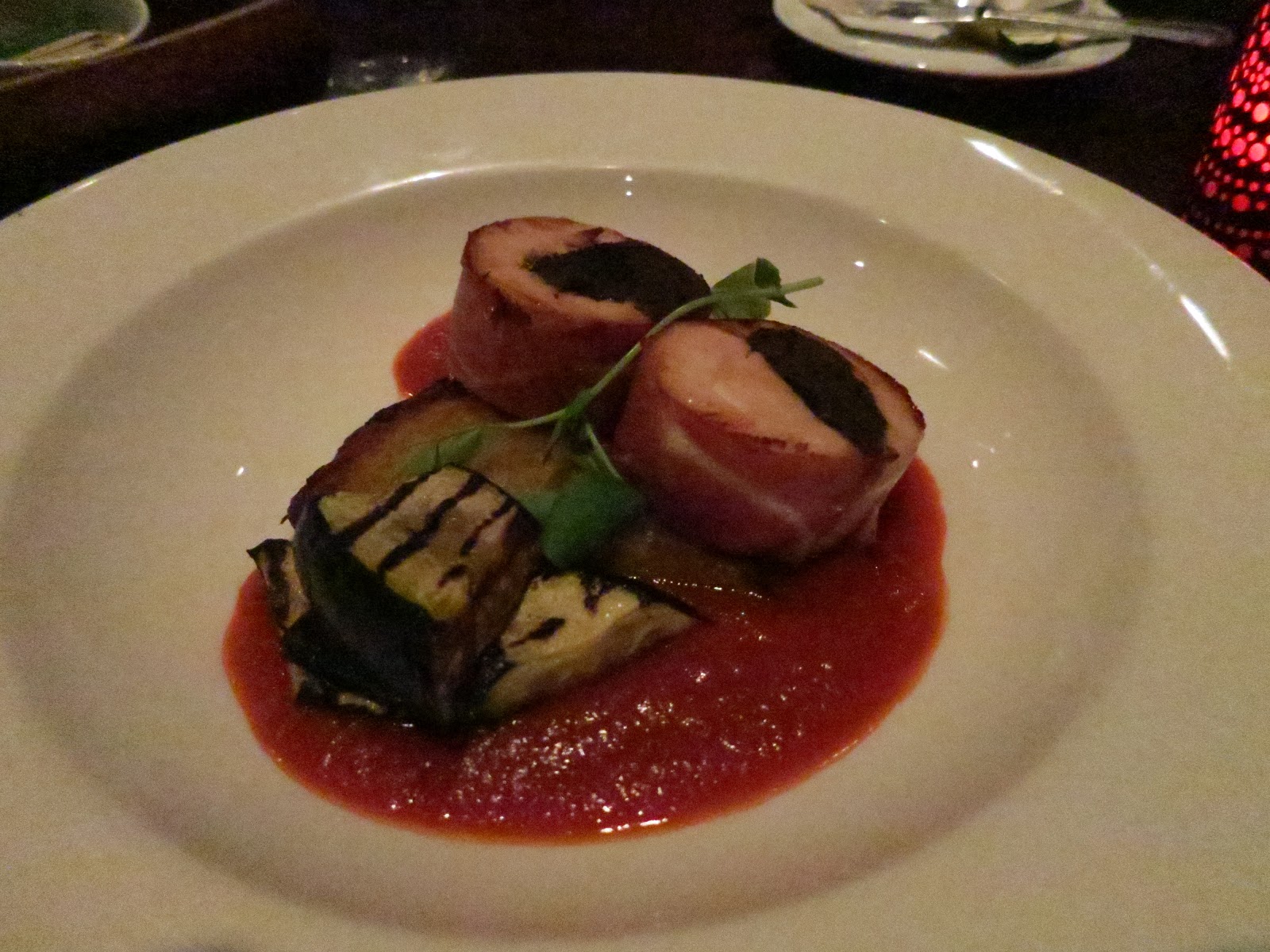
The first entree is Parma ham wrapped chicken and black pudding. Since I'm in Scotland, I should have black pudding, but I'm not really into blood sausage. So, this was the perfect compromise for me. It was served on top of tomato and red pepper sauce. Because of red pepper, it wasn't too acidic and tasted very sophisticated. Unfortunately, the choice of chicken meat was breast and it was overcooked. Although the black pudding and the sauce gave some moistness, it was still dry... Flavor and seasoning were spot on, though.


The next entree is braised ox cheek. The Madeira jus was very rich and the ox cheek was very tender and moist. It could have had a little more salt, but very good dish otherwise.


This is a good start to the trip. I signed up for the tour to Loch Ness and a Highland distillery tomorrow!

Thursday, November 24, 2016

Ho Chi Minh city - Cooking class

Today is the last day in Vietnam and also the highlight of the trip, the full day cooking class from Ho Chin Minh Cooking Class. For this class, I chose 8 dishes and 1 dessert from the list posted on their website.

At 7:30 am, I was picked up at the hotel and transferred to their farm, which is outside of the city. Because of the awful traffic in the city, it took 2 hours to get there (it was originally expected to be 1 hour). Compared to other large cities in Southeast Asia, such as Bangkok and Yangon, Ho Chi Minh City is the most chaotic, from my experience.

When I arrived, they showed us their small farm and had us pick ingredients for the cooking class.


This is lemongrass. I thought that each stalk grows individually. I wouldn't have expected this bush to be lemongrass.

Here is the Oyster Mushroom "cave".  The bags are filled with wood shavings that have already been colonized by the spores. The mushrooms grow from a "spout" at the end of the bag and can be harvested by tearing them off - more mushrooms will then grow back in their place.
Each bag will eventually produce 20 kg worth of mushrooms!


The first dish is the spring roll. I've made this before by myself and it's pretty easy to make. But I chose the dish because I wanted to know how to wrap it properly and how to make the shrimp look nice. The wrapping procedure was nothing new to me. But I learned that shrimp should be inserted after partially wrapped. Then, only single sheet of rice paper is on top of the shrimp so that the color of the shrimp is more prominent. Also, I found the rice paper we used in the class is much thinner than what I'm used to, so I only needed to splash water on the rice paper instead of soaking in warm water. The dipping sauce wasn't the peanut based sauce that I'm accustomed to, but a watery fish sauce- and citrus juice-based sweet and spicy sauce. I learned that Vietnamese fish sauce is less pungent than that from Thai cooking. I would expect the sauce to be very fishy if I had used Thai fish sauce to make the same sauce.

The next dish is the lotus rootlet salad with grilled pork. I've had lotus rootlet salad before in the US. That's why I requested this dish. I didn't know that it comes with grilled pork. Despite the meat, it's still refreshing.

This is something unique. The lotus rootlet salad above is wrapped with mustard leaves. The wrapped salad and shrimp are tied with a chive. The dipping sauce is the same as the one for the spring rolls.


This is Pho Bo (beef). I was so glad that we made this from scratch. I was worried that they might prepare the broth ahead of time and just have us assemble the finished soup because it takes so long to make the broth. They had me make the broth as soon as I arrived with beef bones and spices. I was really excited because that's the part I wanted to learn. The rest is simple. Season the broth with fish sauce, sugar and salt. A simple but flavorful dish.


This is the dessert, banana spring roll along with coconut cream. It's the end of morning session. The dessert is very simple but satisfying. The coconut cream was premade, though.


After a short break (resting in a hammock), I started to work on the rest of the 4 dishes. In the morning session, I made each dish one at a time. In the afternoon session, however, I worked on all 4 dishes at once.

First, stir fried shrimp and veggies with tamarind sauce. The shrimp are tossed in egg white and tapioca starch, and then deep fried. They are then stir fried with veggies and tamarind sauce. I would say this is the Vietnamese version of sweet and sour shrimp.


The photo may not do this dish justice. But it is braised pork cooked in a clay pot. The seasoning is basically fish sauce and caramelized sugar. Because of the caramelized sugar, it gets dark and looks salty. But in fact it's well balanced.


Grilled pork on the rice vermicelli. This is pretty standard Vietnamese dish at Vietnamese restaurants in the US. The only difference is the lack of lettuce. Instead, I chopped various herbs and added enough to replace the lettuce that I would normally expect.


This is fish in the claypot. Basically this is prepared in the same way as the pork dish above. One unique ingredient is a hard boiled egg. Before it is added to the claypot and braised, the egg is seared in the wok. The instructor said that the egg will keep it's shape by the process of searing it.


As I expected 8 dishes and 1 dessert was A LOT!! I was super full after I made everything. I'm leaving tonight and have time for a dinner. But I don't think I can eat anything before the flight.

I was expecting hot and humid weather before I came to Vietnam. Luckily it wasn't that hot by Vietnam standards, yet it's still quite hot. But what killed me is the humidity. I feel like I sweated enough for a year worth on this trip... But I believe the amount of sweat will compensate for the weight gain from all the food.

Wednesday, November 23, 2016

Ho Chi Minh - Street food tasting tour

I took the afternoon flight from Hue to Ho Chi Minh City and then cab into the city. I was expecting some traffic in Ho Chi Minh City but it's much worse than what I thought. I was a bit nervous that I wouldn't make it to the evening street food tasting tour, because of time.

I did make it but it took more than 1 hour for 7 km ride. I've seen crazy traffic with tremendous numbers of motorbikes on TV before, but now I see that, in Ho Chi Minh City at least, that it does actually exist - that's no exaggeration!  It seems that no regular traffic rules apply and it's unbelievable I don't see any accidents...

A little bit after I checked into the hotel, the street tour guides arrived at the hotel to pick me up. I booked this tour from Vietnamstreetfoods.com. They offer both motorbike and walking options. Although I wouldn't have to drive the motorbike myself, I felt uncomfortable to even sit on the back in such crazy traffic, so I chose the walking option. The two guides arranged a taxi and took us to district 4 (my hotel is in the district 1). It's only a few km but it took more than 30 min....

The food market/stands area in this district is huge We started from the fruit section. The guides told me that I can choose any fruits I'm interested in. Two fruits grabbed my attention.


The first is a custard apple.  It looks like a young pine cone. It does taste like cherimoya that I tasted in Peru. In fact this has more flavor than cherimoya and it was really good. The only problem is the custard apple is much smaller than cherimoya (slightly smaller than tennis balls). There are many seeds and the skin tastes bitter. It needs some experience to eat this.


The second fruit is milk fruit. It's called this way because the juice resembles to milk. The guide told me a story about this fruit but I didn't quite understand it completely. They are the third guides since I arrived in Vietnam. Unfortunately, the English level of the Vietnamese guides (also hotel staff) is not as high as other countries I've visited. They all have great personalities to make it up for, though.


This is the milk fruit after cutting into half, seeds stayed on the other half (like an avocado)


This is fresh sugar cane juice with kumquat. It's still pretty sweet but not syrupy. The added kumquat juice makes it refreshing.

This is the kumquat used in the sugar cane juice


After the fruit section, we moved to "cooked" foods vendors area. The first snack was fried dough with minced meat inside. This is the Vietnamese version of piroshki. The guide told me the name but unfortunately I don't remember it....


Suddenly, one of the guides asked "do you like snake wine?" Not really... But I said "why not," instead. So, it's the snake infused (?) wine. I don't know what exactly the liquor is. It tasted neutral, like vodka. In fact it was as strong as vodka in terms of alcohol. I don't know what snake is supposed to taste like. But I didn't taste anything unusual. Just a strong liquor flavor.


The next stop is bahn mi. This is the second bahn mi after the one I tasted in Hoi An (the one Anthony Bourdain visited). This one is made with various meat products. Very flavorful with spiciness and sweetness. But I liked the other bahn mi better.


Next, a short break with fresh coconut juice. I chose the chilled coconut since it's very hot and humid. When ordered, they cut the top off and stick a straw. It tasted very fresh. The guide told me that it takes a day to chill the juice completely because of the thick coconut flesh,


This is something I've never had. Minced meat is mixed with seasoning and wrapped in betel leaves. They are grilled at the front. Smells wonderful!

They are served with rice paper, rice noodles and a veggie/herb plate. The two unique veggies on the plate are starfruit and and young banana. Both are sliced thinly and give a hint of bitterness. The rice paper is very thin and I didn't have to soak it in water. After wrapping everything with the rice paper, the whole roll is dipped into the fish sauce based dipping sauce. Very good.


This is Pho!! It's a hot and humid day (although it was after 7:00pm by then) and inside the restaurant it was like a sauna because of the boiling pho broth. The girl in the photo below was drenched in sweat. Vietnam is a very hot country. I wonder how so many soup noodles dishes became popular in such an environment...

The beef was lightly cooked in the boiling broth, so it's not as rare as what I'm used to

The guide showed me how to make dipping sauce for the beef. You can directly add the condiments to the broth or dip the meat. But it seems more Vietnamese to eat Pho the second way (at least among the Vietnamese around me). It's hoisin sauce (the guide called it sweet soy), hot sauce, citrus juice (kumquat) and house made chili sauce (dried chili flakes in oil). These are mixed before dipping. So far, I haven't seen "World wide famous Sriracha" in Vietnam!! I saw something similar, though. Sriracha is manufactured in the US. So, I guess Sriracha is the US version of the Vietnamese hot sauce  made by Vietnamese immigrants in the US.


The last stop of the tour is seafood! The scallop below is grilled with shallot, scallion and peanuts. Served with sauce. Don't know what the ingredients for the sauce but I guess shrimp paste is included. Very savory sauce.

Grilled shrimp with chili. When I taste the shell, it's very spicy. But after being peeled, there's only a hint of spiciness. Very fresh shrimp. Also, it comes with a similar dipping sauce.

This seafood eatery had many different varieties of seafood. I saw some giant clams that I've never seen. If I was going to stay longer, I would like to come back here.

During the tour, we had quite a few things that came with ice, such as sugarcane juice, teas and even beer. I didn't feel completely comfortable with this (because of the unknown water source) but I gave up eventually because it was so hot and I needed something cool. Many of the ice "cubes" were big cylinders with a whole on one side. After I came back to the hotel, I Googled the ice in Vietnam in general. It seems this big cylindrical ice is safe to consume. Even other types of ice are usually ok in big cities. I should have checked this before I came to Vietnam....

Tomorrow is a full day cooking class!